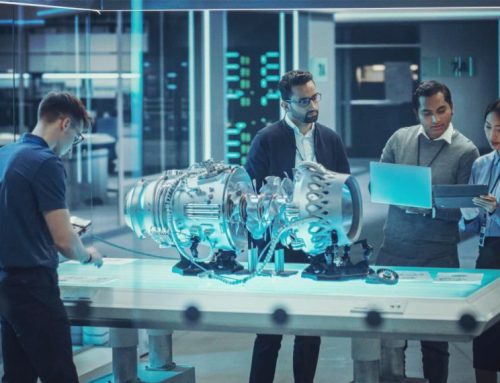
Industries like aerospace, automotive, and medical need high precision and smooth finishes. Traditional machining methods are often not enough for such work, while modern manufacturing involves complex and detailed parts. This is where 5-axis CNC machining becomes important. Because the machine can easily handle intricate geometries and complex curves, engineers are no longer constrained by flat surfaces or simple shapes. This frees designers from worrying about manufacturing constraints to concentrate more on functionality and performance.
For example, parts can be made lighter by eliminating extra material without sacrificing strength, which is crucial in sectors like aircraft. Additionally, 5-axis machining facilitates rapid prototyping, which enables businesses to test and refine designs more quickly. This helps companies launch new goods faster by accelerating the cycles of product development.
5-axis machining helps manufacturers create complex parts faster and with better accuracy. It also reduces the need for multiple setups, saving both time and cost.
What is 5-Axis CNC Machining?
5-axis CNC machining is a process where a cutting tool moves in five different directions. In basic machining, the tool moves in three axes: X, Y, and Z. These cover up-down, left-right, and forward-backwards motion.
In 5-axis machining, two more rotational movements are added. This allows the tool to reach the part from different angles without moving the part again and again.
There are two main types:
- 3+2 axis machining: The part is fixed at a certain angle, and cutting happens in three axes.
- Simultaneous 5-axis machining: All five axes move at the same time for more complex shapes.
Reducing material waste and enhancing overall sustainability are two more significant aspects of 5-axis machining. Because the procedure is so exact, there is less possibility of mistakes, which results in fewer pieces being rejected and less material being wasted. Energy consumption and machine time are also decreased by being able to finish the majority of the task in a single configuration.
Why 5-Axis Machining is Important
As designs become more advanced, manufacturers need better tools. 5-axis machining meets this need in several ways.
Better Accuracy
Since the part does not need to be moved multiple times, errors are reduced. The tool stays closer to the part, which improves accuracy.
Complex Shapes
5-axis machines can create curves, deep pockets, and angled features easily. This is very useful for parts like turbine blades and moulds.
Less Setup Time
In traditional machining, the part needs to be repositioned many times. In 5-axis machining, most work is done in one setup. This saves time and effort.
Smooth Surface Finish
The tool can stay at the best angle while cutting. This gives a smoother surface and reduces the need for extra finishing work.
Longer Tool Life
Better angles mean less stress on the tool. This increases tool life and reduces replacement costs.
Applications of 5-Axis Machining
5-axis CNC machining is used in many industries because of its flexibility.
Aerospace
In aerospace, parts must be strong, light, and precise. 5-axis machining is used to make turbine blades, engine parts, and structural components.
Medical Industry
Medical tools and implants need high precision. 5-axis machines help create detailed and accurate parts like joint implants and surgical tools.
Automotive
Car manufacturers use 5-axis machining for engine parts, moulds, and prototypes. It helps improve performance and design.
Energy Sector
Industries like oil and gas use 5-axis machining to produce parts such as valves and turbine components.
Defense
Defence equipment requires strong and accurate parts. 5-axis machining helps meet strict quality standards.
Advantages Over Traditional Machining
Compared to 3-axis machining, 5-axis machining offers clear benefits.
- Fewer setups, which saves time
- Better accuracy and fewer errors
- Ability to make complex designs
- Faster production
- Reduced need for manual work
Even though the machine cost is higher, overall savings can be seen in the long run.
Challenges in 5-Axis Machining
While 5-axis machining has many benefits, it also has some challenges.
High Cost
The machines and software are expensive. Small businesses may find it hard to invest.
Skilled Operators Needed
Operating a 5-axis machine requires training and experience. Not everyone can handle it easily.
Complex Programming
The tool paths are more complex. Advanced CAM software is needed to control the machine.
Maintenance
Regular maintenance is required to keep the machine accurate and working well.
Role of Software
Software plays a big role in 5-axis machining. CAM software helps create tool paths and simulate the process before actual cutting.
This helps in:
- Avoiding collisions
- Improving efficiency
- Reducing errors
- Saving material
Modern systems also allow real-time monitoring, which improves control over the process.
Future of 5-Axis Machining
The future of 5-axis machining looks strong. With new technology, it is becoming more efficient and easier to use.
Automation
Robots are being used with 5-axis machines to reduce manual work and increase speed.
Smart Manufacturing
Machines are now connected through digital systems. This helps track performance and improve output.
Hybrid Manufacturing
Combining 5-axis machining with 3D printing is becoming popular. This allows more design flexibility.
New Materials
As new materials are developed, 5-axis machines are being updated to handle them better.
When to Use 5-Axis Machining
5-axis machining is best when:
- The part has a complex design
- High precision is needed
- Multiple setups are required in traditional machining
- Surface finish is important
For simple parts, 3-axis machining may still be enough and more cost-effective.
Conclusion
5-axis CNC machining is a powerful solution for modern manufacturing. It helps produce complex parts with high accuracy and better efficiency. By reducing setup time and improving surface finish, it offers clear advantages over traditional methods. Because of this, they can be used in a wide range of applications, from big industrial components to tiny medical devices. Furthermore, a variety of materials, such as metals, polymers, and sophisticated composites, can be processed by contemporary 5-axis machines. 5-axis machining continues to be crucial for enhancing productivity, quality, and resource management as industries shift toward more intelligent and effective manufacturing techniques. Although the initial cost and skill requirements are high, the long-term benefits make it a valuable investment. As industries continue to demand better designs and faster production, 5-axis machining will play an even bigger role in the future of manufacturing.