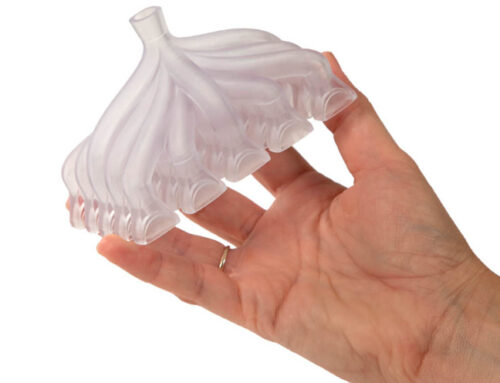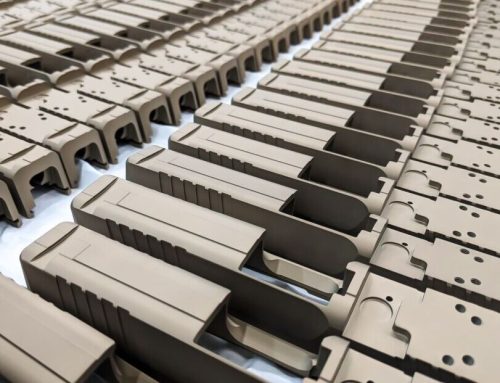
3D-printed molds provide a good cost effective alternative to rapid prototyping as you can leverage additive manufacturing to create mold cavities, inserts, and tooling components straight from digital designs. By using this method, firms can also evaluate product designs before investing in costly production tooling, cutting down on tooling development time and initial expense.
Injection molding, silicone casting, resin casting, thermoforming, and other low-volume manufacturing methods can all use 3D-printed molds, depending on the application.
What Are 3D-Printed Molds?
In simple terms, the 3D printed molds are created using tooling components and additive manufacturing technology. You can create 3D-printed with intricate geometries, integrated cooling channels, and bespoke cavity designs that might be challenging or costly to create using conventional processes as conventional molds require CNC machining metal blocks into accurate cavities.
Usually, they are created straight from a digital model utilizing computer-aided design (CAD) software .It means with an effective way .
A variety of materials can be used to create the molds, such as:
Photopolymer resins: Used in certain low-pressure applications, casting, and master patterns.
Thermoplastics: Depending on the printing technology and process specifications, these include ABS, polycarbonate, and engineering polymers.
High-temperature polymers: Used in specific tooling applications where a high level of thermal resistance is necessary.
Metal powders: Used in metal additive manufacturing to create robust molds and tooling inserts for demanding applications.
The molding technique, operating temperature, injection or casting pressure, necessary surface polish, and anticipated tool life all influence the choice of material.
Production Methods for 3D-Printed Molds
Molds and tooling components can be made using a variety of additive manufacturing technologies.
By extruding thermoplastic filament via a heated nozzle and depositing material layer by layer, fused deposition modeling (FDM) creates components.
Benefits
- Comparatively inexpensive materials and equipment.
- Short lead times for production.
- Ideal for basic geometries and big tooling components.
- Simple design changes and tool replacement.
For prototype molds, compression tooling, casting patterns, and some low-pressure molding applications, FDM is frequently taken into consideration.
SLA, or stereolithography
SLA creates components with smooth surfaces and precise features by selectively curing liquid photopolymer resin using a light source.
Benefits
- High dimensional precision for appropriate geometries.
- Smooth polish on the surface.
- Fine characteristics are reproduced well.
- Ideal for complex master designs and cavities.
SLA is very helpful for some low-volume tooling applications, casting molds, and master patterns.
SLS, or selective laser sintering
SLS fuses polymer powder into solid components using a laser.
Benefits
- Able to create intricate shapes without the need for traditional support structures.
- Ideal for complexly shaped utilitarian tools.
- Provides more geometric freedom than many traditional methods of machining.
Customized tools, fixtures, casting applications, and specific prototype mold components can all benefit from SLS.
Manufacturing using Metal Additives
Metal tooling inserts with intricate internal channels and conformal cooling geometries can be created using technologies like laser powder bed fusion.
Benefits
- When appropriately built, higher temperature and pressure capabilities are possible.
- Conformal cooling channels have the potential to increase cooling efficiency.
- Appropriate for more complex tooling applications.
In general, metal additive manufacturing is more applicable to production-oriented applications and sophisticated tooling than to the most affordable prototyping scenarios.
How 3D-Printed Molds Lower the Cost of Prototyping?
The decrease in initial tooling costs and development time is the main financial benefit of 3D-printed molds.
Other benefits includes:
Reduced Initial Investment in Tools
Machining, specialized fixtures, toolpath programming, and multiple finishing procedures may be necessary for traditional metal tooling. These expenses can be challenging to justify for a prototype that might only require a small number of pieces.
Additive manufacturing can facilitate the production of an initial mold at a reduced cost by eliminating the requirement for intensive machining and specialized equipment.
Shorter Lead Time
Depending on the intricacy, material, and finishing requirements, the production of a conventional mold can take days or weeks. Although design, post-processing, and validation must also be taken into account, a 3D-printed mold might be created in a matter of hours or days.
Engineers can test designs earlier, find issues sooner, and speed up product development with shorter lead times.
Quicker Iterations in Design
During product development, design modifications are frequently made. A cavity modification with traditional tooling could need more finishing and CNC machining process.
A redesigned mold or insert can be made using 3D printing and the updated CAD model. Testing various geometries, draft angles, wall thicknesses, and parting-line combinations is made simpler as a result.
Decreased Material Waste
Additive manufacturing mostly creates material where the design calls for it. Compared to subtractive machining, which takes material from a larger block, this can minimize material waste. However, a thorough cost analysis should include account for post-processing waste, unused powder, failed prints, and support infrastructure.
Reduced Storage and Inventory Needs
When needed, digital mold designs can be saved and replicated. Although approved designs, material specifications, and process records must still be kept, this lessens the need to keep physical stocks of each prototype tool.
Cost Comparison: 3D-Printed Molds vs. Conventional Molds
The most economical approach depends on the required quantity, material, mold complexity, production process, and acceptable part quality. Additionally, they save development costs and material waste in appropriate applications by enabling the rapid implementation of design alterations without requiring substantial machining. Conventional molds, on the other hand, are more durable and can offer a cheaper cost per item for high-volume manufacture, but they usually require a larger initial investment owing to machining, tooling materials, and finishing procedures.
When only a small number of pieces are required, 3D-printed molds can dramatically lower overall prototyping costs, even if they may need more frequent replacement and additional post-processing. Therefore, assessing the entire tooling cost, manufacturing quantity, tool life, finishing needs, and cost per acceptable item is necessary to choose the most cost-effective strategy.
Applications of 3D-Printed Molds
Plastic Injection Molding
3D-printed polymer molds or inserts can be used to produce limited quantities of plastic components for design validation and functional testing.
They are most suitable when the polymer mold material can withstand the injection temperature, pressure, and repeated thermal cycling. Conventional metal molds remain preferable for demanding production conditions.
Silicone and Resin Casting
3D printing is particularly useful for manufacturing master patterns or direct molds for silicone, polyurethane, epoxy, and other casting materials.
These applications often involve lower pressures than injection molding, making them suitable for a wider range of printed materials.
Surface Quality
Layer lines, porosity, and stair-stepping may transfer to molded components. Sanding, polishing, sealing, or applying a suitable coating may improve the final finish.
Dimensional Accuracy
Shrinkage, warping, build orientation, post-curing, and thermal expansion can affect cavity dimensions. Critical dimensions should be inspected and, where necessary, compensated for during CAD design.
Tool Life
Printed molds may experience wear, cracking, erosion, or deformation during repeated cycles. Expected service life should be validated through representative molding trials rather than assumed from material specifications alone.
While conventional molds are still a sensible option for high-volume manufacturing, 3D-printed molds offer an efficient alternative for quick prototyping and low-volume production, especially when speed, flexibility, and a lower initial investment are crucial.